
Lewis Latimer: The Foundational Black American Inventor Who Helped Light the World
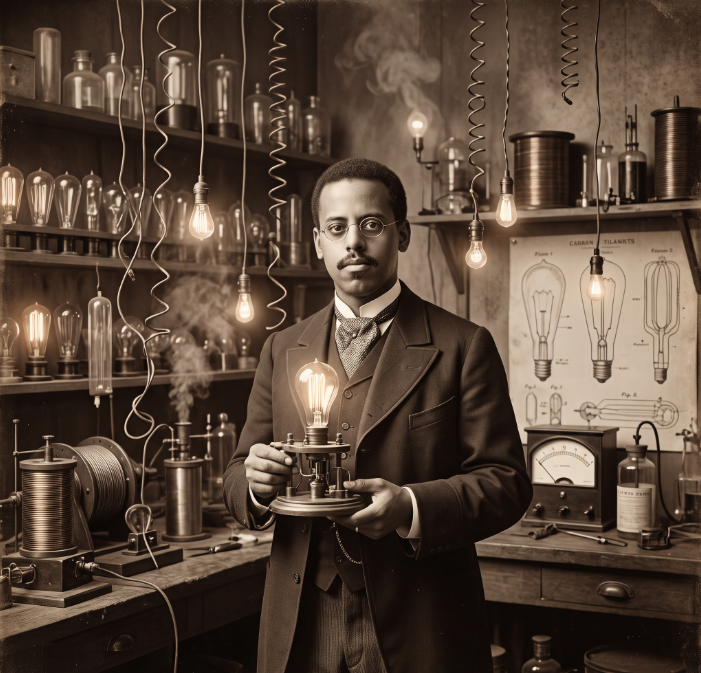
When the history of American innovation is discussed, names such as Thomas Edison and Alexander Graham Bell are often among the first mentioned. But another brilliant inventor, engineer and draftsman played an important role in the development of both electric lighting and the telephone: Lewis Howard Latimer.
A Foundational Black American born on September 4, 1848, in Chelsea, Massachusetts, Latimer was the son of George and Rebecca Latimer, who had escaped slavery in Virginia several years before his birth. At just 16 years old, Lewis enlisted in the U.S. Navy during the Civil War. After his military service, he eventually found work at a Boston patent law firm, where he taught himself mechanical drawing and developed into a highly skilled draftsman.
Helping Alexander Graham Bell Patent the Telephone
One of Latimer's earliest contributions to American technology came through his work with Alexander Graham Bell.
Bell hired Latimer to prepare the detailed technical drawings needed for his telephone patent application. Latimer worked with Bell as he raced to secure legal protection for the revolutionary invention, and Bell's application was filed on February 14, 1876. Latimer's drafting expertise therefore placed him directly alongside one of the most important technological developments of the 19th century
His Important Contribution to Electric Lighting
Latimer later turned his attention to electric lighting while working for Hiram Maxim's U.S. Electric Lighting Company.
Contrary to a common misconception, Latimer did not invent the light bulb itself. Instead, he made important improvements to the technology surrounding incandescent lighting. Most notably, he developed an improved process for manufacturing the delicate carbon filaments used inside early electric lamps.
On January 17, 1882, Latimer received U.S. Patent No. 252,386 for his “Process of Manufacturing Carbons.” His technique protected the fragile carbon material during production, helping make filaments more consistent and durable. The U.S. Patent and Trademark Office credits his work with helping make electric lighting more practical and affordable.
Latimer's expertise wasn't limited to a drawing board. He also helped oversee the installation of electric-lighting systems, including work in the United States and overseas.
Working With Thomas Edison
In 1884, Latimer went to work for Thomas Edison's organization. His knowledge of electrical technology, patents and technical drawings made him particularly valuable.
Latimer became involved in patent investigations and served as an expert in disputes surrounding Edison's electrical inventions. In 1890, he published Incandescent Electric Lighting: A Practical Description of the Edison System, a technical book explaining the developing electric-lighting system.
His achievements were eventually recognized by the Edison Pioneers, an organization honoring people who had participated in the early development of Edison's electrical industry. When Latimer became a charter member in 1918, he was the group's only African American member.
More Than the Light Bulb
Latimer's inventive career extended beyond electric lighting. His patents included improvements involving railroad-car toilets, electric lamps and lamp fixtures, among other technologies. The Smithsonian preserves examples of his technical drawings, reflecting both his engineering knowledge and remarkable skill as an illustrator.
He was also a writer, poet, musician and educator. In his later years, Latimer taught mechanical drawing and other subjects to immigrants and participated in civil-rights activities, making his contributions broader than technology alone.
A Legacy That Deserves Recognition
Lewis Latimer died on December 11, 1928, at age 80. Decades later, recognition of his accomplishments continued to grow. In 2006, he was inducted into the National Inventors Hall of Fame for his process of manufacturing carbon filaments for electric lamps.
Latimer's story is particularly remarkable because he built his career during an era when opportunities for Black Americans in science, engineering and professional industries were severely restricted by racism and discrimination.
From preparing the drawings associated with Bell's telephone patent to advancing practical electric lighting, Lewis Latimer helped shape technologies that transformed everyday life. His story is an important reminder that the history of American innovation includes Black inventors whose contributions were essential—even when their names did not receive the same recognition as their more famous contemporaries.
Lewis Howard Latimer (1848–1928) 💡
Inventor • Engineer • Draftsman • Author • Pioneer
