
Sarah Boone: The Black Inventor Who Improved the Ironing Board
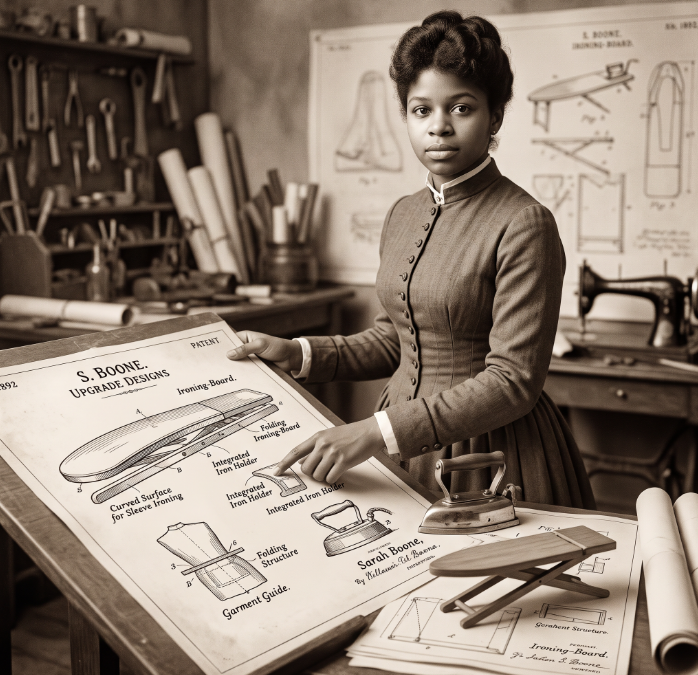
During the late 19th century, Sarah Boone became one of the pioneering Black women whose ingenuity helped improve everyday American life. Boone is best remembered for receiving a U.S. patent for an improved ironing board, designed to make pressing women's clothing—particularly sleeves and fitted garments—easier and more effective.
Born Sarah Marshall in 1832 in North Carolina, Boone was born into slavery. She later married James Boone, and the couple eventually settled in New Haven, Connecticut, where Sarah worked as a dressmaker. At a time when Black Americans and women faced enormous barriers to education, business ownership and professional opportunities, Boone's accomplishments were remarkable.
A Historic Patent
On April 26, 1892, Boone received U.S. Patent No. 473,653 for her improvement to the ironing board. She is widely recognized as the fourth known Black woman in U.S. history to receive a patent, following Judy W. Reed, Sarah E. Goode and Miriam E. Benjamin. This achievement placed Boone among a small group of pioneering Black women inventors whose innovations received federal patent protection during the 19th century.
It is more precise to describe Boone as the fourth known Black woman to receive a U.S. patent, rather than the fourth to "own" one, because historical records of early Black inventors are incomplete.
A Dressmaker Finds a Better Way
Boone's work as a dressmaker helped inspire her invention. At the time, clothing was commonly ironed on flat tables or wooden boards. While those surfaces worked for large pieces of fabric, they made it difficult to properly press narrow sleeves and the curved areas of women's garments.
Boone designed a narrow, curved and padded ironing board that allowed a sleeve to be slipped over the surface. This made it easier to iron garments smoothly while reducing unwanted creases. The board could also be turned, allowing both sides of a sleeve to be pressed more conveniently.
In her patent, Boone explained that her invention was particularly suited for ironing the sleeves and bodies of ladies' garments.
Improving an Existing Idea
Sarah Boone did not invent the first ironing board. Instead, she recognized the limitations of existing ironing surfaces and developed an important improvement.
That distinction makes her story an excellent example of how innovation works. Inventors don't always create an entirely new object; sometimes they take something people already use and make it more practical, efficient and useful.
Breaking Barriers as a Black Woman Inventor
Boone's achievement becomes even more significant when viewed within the period in which she lived. Born into slavery in the South, she eventually became a professional dressmaker in Connecticut and secured a federal patent less than three decades after the abolition of slavery.
As a Black woman in the 1800s, Boone faced both racial and gender discrimination. Yet she was able to turn knowledge gained through her profession into an invention recognized by the U.S. government.
Becoming the fourth known Black woman to receive a U.S. patent placed Boone in an extraordinary group of innovators who challenged expectations about who could participate in America's technological and entrepreneurial development.
Sarah Boone's Lasting Legacy
Boone's ironing-board improvement might seem simple compared with inventions such as the telephone or electric light, but inventions designed to solve everyday problems can have an enormous impact on people's lives.
Her story also highlights the contributions of Black women inventors whose accomplishments were often overlooked in traditional accounts of American history.
Sarah Boone died in 1904, but her name remains connected to ingenuity, perseverance and practical innovation.
Sarah Boone (1832–1904)
Inventor • Dressmaker • Innovator
