
A remarkable archaeological discovery in Sudan is bringing renewed attention to a fascinating chapter of African history that is often overlooked.
Archaeologists have uncovered new sections of a massive medieval church in northern Sudan, revealing evidence of a powerful African Christian civilization that flourished centuries before the modern era.
The structure, known as the Great Church of Jesus, is in the ancient city of Old Dongola, once the capital of the Christian Kingdom of Makuria.
Researchers believe the church may have been the largest and one of the wealthiest religious buildings in medieval Nubia. Its estimated footprint is even larger than that of the White House in Washington, D.C.
Although the structure was first identified in 2021, new findings announced in November 2026 have revealed important architectural features, including its original floor and a previously unknown adjoining church.
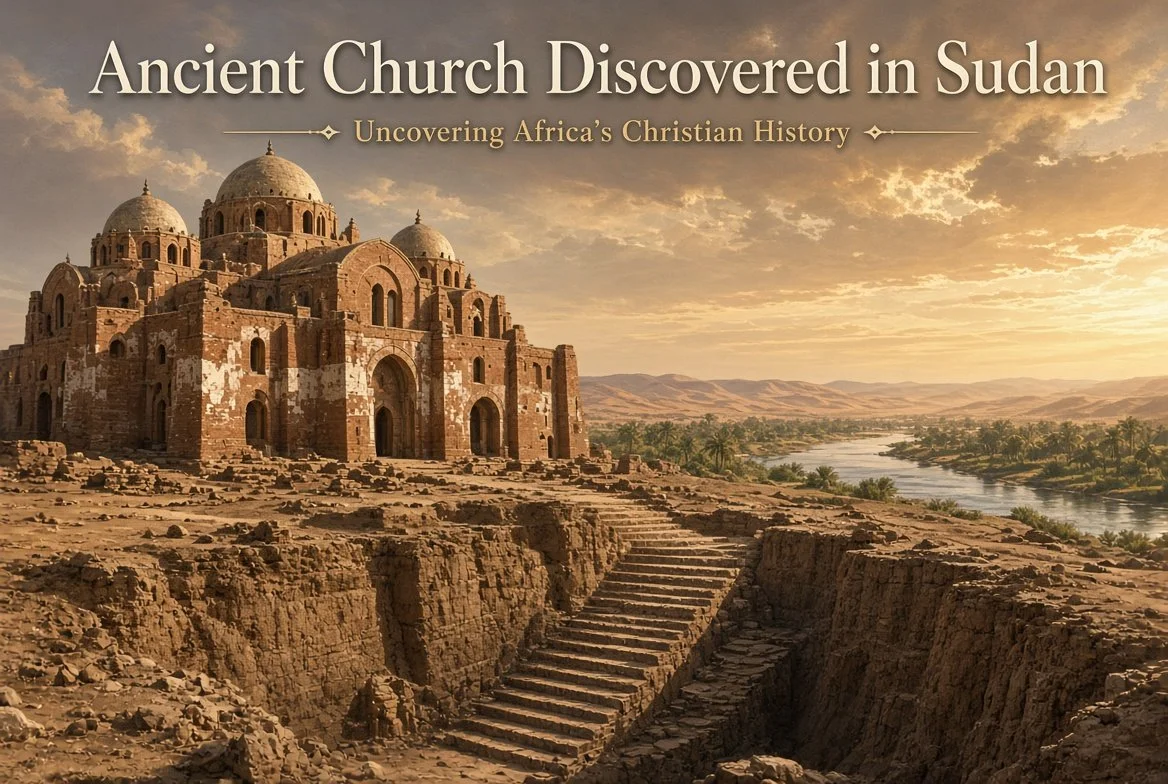
Ai reconstruction of Sudanese Church
The archaeological excavation is being conducted by a joint Sudanese-Polish team led by Professor Artur Obłuski of the Polish Centre of Mediterranean Archaeology at the University of Warsaw, working with Sudan's National Corporation for Antiquities and Museums.
During their latest excavations, researchers uncovered a monumental staircase leading into the Great Church of Jesus.
The staircase was surrounded by walls reaching approximately 36 feet high, allowing archaeologists to reach part of the church's original floor for the first time.
Researchers also discovered massive architectural supports surrounding the church's apse, the rounded area traditionally associated with the altar.
The structure is estimated to have measured approximately:
154 feet wide
187 feet long
At least 69 feet tall
These measurements suggest that the church was among the most impressive religious buildings in medieval Africa.
However, much of the structure remains buried, and researchers emphasize that additional excavations are necessary to determine its complete architectural layout.
The Kingdom of Makuria: Africa's Forgotten Christian Powerhouse
The discovery is particularly significant because it highlights the extraordinary history of the Kingdom of Makuria.
Located along the Nile River in what is now Sudan, Makuria was one of several Christian Nubian kingdoms that emerged during the sixth century.
Its capital, Old Dongola, developed into a major political, religious, and cultural center.
Christianity had a powerful presence in the region, influencing architecture, education, religious traditions, and artistic expression.
For centuries, Nubian rulers governed thriving communities that maintained diplomatic, cultural, and religious connections with neighboring African societies and the wider Mediterranean world.
The kingdom developed its own distinctive Christian traditions, combining influences from the Byzantine world and Egypt with local Nubian culture.
The Great Church of Jesus provides physical evidence of the wealth, architectural knowledge, and religious importance of this African civilization.
Another Church Discovered Within the Complex
One of the most surprising findings was the discovery of a second church constructed on an upper floor of a building adjoining the Great Church of Jesus.
Archaeologists uncovered fragments of painted plaster that once decorated its interior walls.
Although much of the original artwork has deteriorated, the surviving fragments suggest that the smaller church contained elaborate religious paintings.
Researchers also identified Greek inscriptions featuring biblical prayers and religious songs.
Among the writings was part of the Prayer of Hannah, a biblical passage associated with the mother of the prophet Samuel.
The discovery provides valuable evidence of the religious practices, literacy, and artistic traditions of medieval Nubian Christians.
It also demonstrates the cultural sophistication of a society whose history has not always received widespread attention.
A Cathedral That May Have Influenced African Architecture
Professor Obłuski believes the Great Church of Jesus may have played an important role in shaping church architecture throughout medieval Nubia.
He has compared its potential architectural influence to that of the famous Hagia Sophia in Istanbul, Turkey.
The comparison does not mean that the Sudanese church was identical to Hagia Sophia. Rather, it suggests that the Great Church of Jesus may have served as an influential architectural model for religious buildings throughout the region.
Its enormous dimensions, location within Old Dongola, and sophisticated construction techniques raise important questions about the religious and political importance of the building.
Researchers are also reconsidering whether another church previously identified as Old Dongola's cathedral held that role.
Further excavations will be needed to establish the Great Church's precise construction date, original purpose, and relationship to other churches in the city.
Challenging Misconceptions About African History
For generations, discussions about ancient African civilizations have frequently focused on Egypt, leaving many other powerful kingdoms and societies less widely recognized.
The discoveries in Sudan challenge incomplete narratives about Africa's historical contributions to religion, architecture, education, and cultural development.
Long before European colonial rule, African societies were constructing monumental religious buildings, developing complex political institutions, and participating in international cultural exchanges.
The Christian kingdoms of Nubia were not isolated communities. They formed part of a broader world connected through trade, diplomacy, religion, and scholarship.
The Great Church of Jesus serves as another reminder that Africa's history is far more extensive and diverse than is often presented.
It also highlights an important historical reality: Christianity has deep roots in Africa, with organized Christian kingdoms flourishing in Nubia more than a thousand years ago.
Protecting Sudan's Cultural Heritage
The discovery comes during a particularly difficult period for Sudan, where ongoing conflict has threatened communities, historic landmarks, museums, and archaeological sites.
Despite these challenges, Sudanese and international researchers continue working to preserve the country's cultural heritage.
The Old Dongola archaeological project also supports surrounding communities.
Researchers have helped install solar-powered water-pumping systems serving approximately 10,000 residents, providing important assistance to households and agricultural activities.
These initiatives demonstrate how archaeological research can contribute not only to understanding the past but also to supporting people living near historic sites today.
Preserving the Great Church of Jesus is therefore about more than protecting an ancient building. It is about safeguarding an important part of Sudanese and African identity.
What Happens Next?
Although researchers have made significant progress, only a small portion of the Great Church of Jesus has been excavated.
Future archaeological work may reveal additional rooms, religious artwork, inscriptions, and architectural details that could provide a clearer understanding of the building's history.
Scientists also hope to determine when the church was constructed and how its role evolved throughout the centuries.
The discoveries could reshape existing interpretations of Old Dongola and its importance within the medieval Christian world.
For archaeologists, historians, and those interested in African heritage, the site represents an extraordinary opportunity to uncover more of a civilization whose accomplishments deserve greater recognition.
The Great Church of Jesus stands as a powerful reminder of the rich civilizations that once flourished along the Nile.
Its towering walls, monumental staircase, religious artwork, and biblical inscriptions reveal a society with extraordinary architectural skills, artistic traditions, and spiritual institutions.
While the discovery does not change the established fact that Christianity has existed in Africa for centuries, it provides new physical evidence of the scale and sophistication of medieval Nubian Christian civilization.
As archaeologists continue their work, the ancient city of Old Dongola may reveal even more extraordinary chapters of Sudan's past.
This discovery is more than the uncovering of an ancient church. It is the rediscovery of an important chapter in African history.
The sands of Sudan are revealing stories of faith, power, innovation, and cultural achievement that have endured for centuries.
