
Charlotte Residents Protest I-77 Expansion, Calling for Protection of West Side Communities
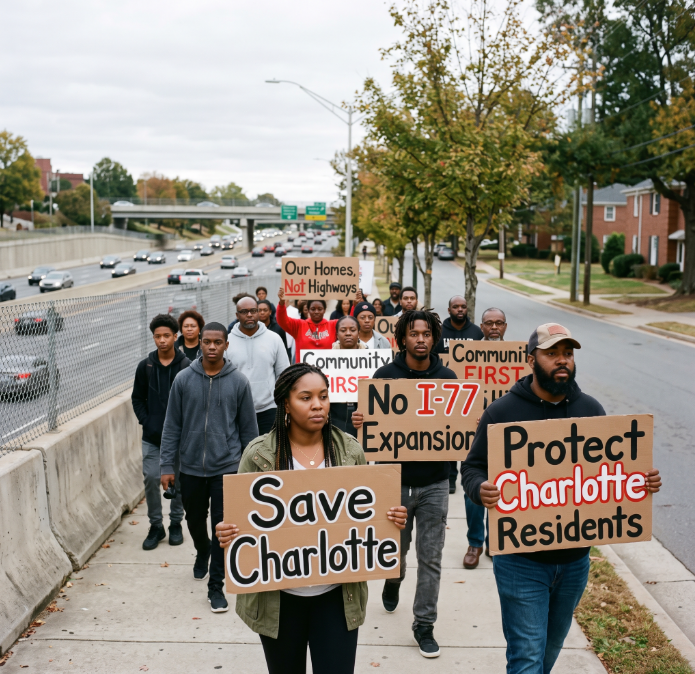
A proposed expansion of Interstate 77 in Charlotte became the center of a major community protest in 2026, as residents from across the city—particularly those living in historically Black neighborhoods on Charlotte’s West Side—organized to demand a greater voice in the future of the corridor.
The controversy surrounded the proposed I-77 South Express Lanes project, which called for new toll lanes along roughly 11 miles of I-77 between the Brookshire Freeway area and the South Carolina state line. One concept included elevated express lanes through portions of West Charlotte. NCDOT argued that elevating lanes in certain areas could reduce the number of homes directly affected compared with widening the interstate entirely at ground level.
“Let Us Speak”
Community frustration became highly visible during a February 2026 town hall at Friendship Missionary Baptist Church. More than 175 people attended, and the meeting eventually ended amid protests from residents chanting “Let us speak!” According to local reporting, many attendees felt they had not been adequately included in decisions that could dramatically affect their neighborhoods.
Opposition was especially strong among residents of communities including McCrorey Heights, Biddleville, Wesley Heights and Oaklawn Park. Their concerns included possible displacement, eminent domain, increased noise and pollution, environmental effects and the visual impact of elevated highway infrastructure.
For residents of historically Black neighborhoods, the debate also carried the weight of Charlotte's past. Earlier highway construction disrupted Black communities, and some residents argued that another major expansion through the same area risked repeating that history. McCrorey Heights neighborhood president Sean Langley criticized the proposed elevated design and questioned whether the community had been given enough meaningful involvement before major design decisions were made.
Protest Moves to City Hall
The opposition soon expanded beyond neighborhood meetings. On February 23, protesters packed Charlotte City Council chambers carrying signs calling for officials to “STOP the I-77 Expansion.” Residents asked city leaders to seek a pause so alternatives could be studied and communities could participate more fully in the process.
Nearly 1,300 residents had signed a petition presented to City Council, while Sustain Charlotte reported that more than 300 people filled the council chamber and that a coalition of neighborhood and community organizations had mobilized around the issue.
The demonstrations produced a significant political response. Nine of Charlotte's 11 council members publicly supported pausing the project at the February 23 meeting, although the city itself did not have unilateral authority to stop the state-led project.
The fight also moved into the courts. On March 2, the Black Political Caucus of Charlotte-Mecklenburg and several McCrorey Heights residents sought a temporary restraining order against the state, arguing that alternatives needed to be adequately considered before the project advanced.
Residents Say the Issue Is Bigger Than Traffic
Many protesters acknowledged that I-77 has serious congestion problems. Their argument was not necessarily that Charlotte should do nothing, but that widening the interstate with toll lanes should not automatically be treated as the solution.
Residents and advocacy organizations called for officials to consider alternatives ranging from greater transit investment to designs that could reconnect neighborhoods rather than further divide them. Some advocates proposed concepts involving highway caps covered with green space.
The toll component created another point of disagreement. Opponents questioned the equity of constructing new lanes that would require drivers to pay for faster travel while the communities living alongside the expanded highway could experience many of its environmental and construction impacts.
Community Pressure Changes the Conversation
The months of demonstrations, petitions, public testimony and organizing eventually influenced the political debate surrounding the project.
In May, Charlotte City Council voted 6-5 to revoke its previous support for the public-private partnership funding approach for the toll-lane project and requested deeper analysis of the proposal and regional transportation alternatives. Charlotte Observer
Then, on May 20, 2026, the Charlotte Regional Transportation Planning Organization voted to rescind its support for the proposed I-77 South toll-lane expansion's public-private delivery approach. Sustain Charlotte, one of the organizations opposing the project, credited sustained participation by residents and community organizations with helping bring about the decision.
The controversy has nevertheless continued. As recently as September 2026, environmental advocacy organization CleanAIRE NC was still urging Charlotte officials to reject an I-77 toll-lane expansion, citing concerns about displacement, affordability and potential air-quality effects on communities along the corridor.
For Charlotte's West Side, the I-77 protests have grown into something larger than a debate over lanes and traffic. They have become a conversation about who gets a voice when Charlotte grows, how historically affected neighborhoods should be protected and whether transportation improvements can be made without placing another disproportionate burden on the communities that live beside the highway.
