
Charlotte’s I-77 Expansion Raises Concerns for West Side Communities
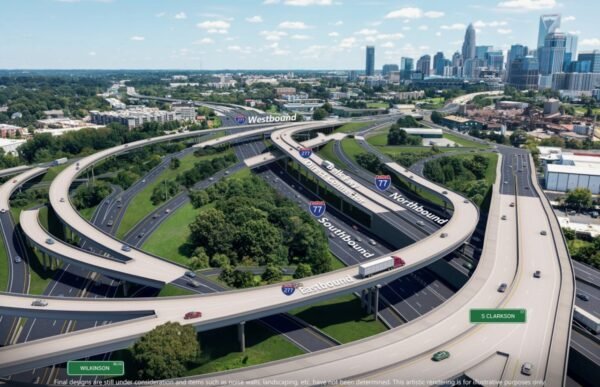
NCDOT rendering of a proposed toll lane design for I-77 South in Charlotte
A major transportation proposal involving Interstate 77 through Charlotte has sparked significant concern among residents, particularly in neighborhoods on the city’s historically Black West Side. The debate has centered on the proposed I-77 South Express Lanes project, which envisioned adding two express toll lanes in each direction along the corridor.
For many residents, the issue goes beyond traffic. Communities including McCrorey Heights, Wesley Heights, Biddleville and Wilmore have raised concerns about property impacts, noise, air pollution, parks and the possibility of neighborhoods once again being divided by highway infrastructure. Residents have pointed to Charlotte’s history, when construction of I-77 displaced and disrupted portions of historically Black communities.
A Fear of History Repeating Itself
Early project concepts caused alarm after maps showed potential impacts to homes and community spaces. In Wilmore, residents were concerned that homes and portions of neighborhood parks could be affected. In McCrorey Heights, residents said the proposal brought back painful memories of the original interstate construction and questioned whether communities that had already sacrificed for transportation infrastructure should be asked to do so again.
NCDOT responded that the plans were preliminary—only about 10% to 15% designed at the time—and developed an elevated express-lane option intended to reduce the highway's footprint. The agency said that option would preserve homes north of the John Belk Freeway, including homes in McCrorey Heights, Wesley Heights and Biddleville, and avoid 41 residential impacts associated with a traditional widening alternative.
Still, residents have argued that protecting houses does not eliminate every impact. They have raised concerns about living beside a larger or elevated highway, including traffic noise, air quality, construction disruption, loss of green space and the visual impact of large concrete structures. NCDOT has said noise, air quality, greenhouse-gas emissions and potential mitigation measures are part of the environmental review.
Toll Lanes and Equity
Another major issue has been the proposed use of tolled express lanes. Critics have questioned whether lanes requiring payment would provide equal benefits to residents of lower-income communities located alongside the interstate. NCDOT had said qualifying low-income drivers would receive a discount program and that carpools, transit vehicles and emergency responders would receive toll-free access.
Supporters of addressing the I-77 corridor point to a genuine transportation problem. According to NCDOT, the corridor experiences significant recurring congestion, and its crash rate is approximately 2.5 times the statewide average for urban interstates. The agency argued that additional managed capacity could improve safety and provide more reliable travel times.
The Project's Status Changed in 2026
Importantly, the controversial proposal is not currently moving forward under its previous plan. On May 20, 2026, the Charlotte Regional Transportation Planning Organization rescinded its support for using a public-private partnership to finance and deliver the I-77 South Express Lanes. NCDOT says that was the project's only financially viable delivery method, so the project is being removed from the state's 2026–2035 transportation improvement program.
That development does not erase the broader discussion about I-77 and Charlotte's West Side. The city is simultaneously pursuing its Reconnecting the West End initiative, which looks at ways to reduce barriers created by I-77 around West Trade and West Fifth streets. Its recommendations include improved pedestrian, bicycle and transit connections, additional greenway space and opportunities to reclaim land currently devoted to highway infrastructure.
For West Charlotte residents, the debate has become about more than whether the region needs transportation improvements. It raises a larger question: How can Charlotte address congestion and future growth without once again asking historically impacted neighborhoods to carry a disproportionate share of the cost?
As Charlotte continues to grow, the controversy surrounding I-77 shows why transportation planning, neighborhood preservation, environmental health and community input are increasingly intertwined. Whatever ultimately replaces or revives the current proposal, West Side residents have made clear that they expect to have a meaningful voice in decisions that could reshape their communities for generations.
